

The Business Immigration Reset: Why PNPs Are Your Only Realistic Path to immigrating to Canada in 2026?

Executive Overview
As Canada recalibrates its immigration system to prioritize economic impact, regional development, and program integrity, traditional federal entrepreneur programs have stalled, tightened, or disappeared. While many prospective immigrants continue to wait for a long‑promised federal entrepreneur or start‑up expansion, the reality on the ground is clear:
Provincial Nominee Program (PNP) Entrepreneur Streams are now the most realistic, structured, and achievable immigration pathway for serious business applicants.
For foreign nationals abroad and temporary residents already in Canada seeking to convert their status to permanent residence, provincial business streams offer: – A clear work‑permit‑to‑PR pathway – Predictable capital thresholds compared to federal programs – Alignment with Canada’s regional labour and economic priorities – Faster and more controllable outcomes for well‑prepared applicants
This article provides a practical, province‑by‑province guide (2026–2027) to Canadian PNP entrepreneur pathways, including eligibility requirements, indicative costs, realistic timelines, and strategic business selection advice.

Introduction: The New Reality of 2026
If you are reading this in early 2026, you likely already know the news: The Federal Start-Up Visa (SUV) is closed to new applicants. The Self-Employed Class is paused. We are all waiting for the details of the promised 2026 Entrepreneur Pilot, but as an immigration professional, I cannot advise you to wait for a maybe.
My name is Pius Ekwulugo, and as a Regulated Canadian Immigration Consultant (RCIC), I am here to tell you that the door to Canada is not shut—but the entry code has changed.
The era of passive investment is dead. The era of the active operator is here. While we wait for federal updates, the Provincial Nominee Programs (PNPs) have become the gold standard. They are currently the most transparent, predictable, and realistic pathways to Permanent Residence (PR) for business people.
Why the PNP Entrepreneur Pathway Matters Now? (And Why Now?)
With the federal backlog clearing, causing a freeze on federal streams, Provinces have stepped up. Recent immigration policy shifts make this pathway especially important:
- Federal caps and program uncertainty
The federal Start‑Up Visa remains highly competitive, backlogged, and dependent on third‑party incubators. - Shift toward regionalization
Provinces are under pressure to address local labour shortages, population decline, and business succession gaps. - Preference for active, operating businesses
Passive investment is no longer favored. Provinces want owner‑operators to create jobs. - In‑Canada status conversion
Many PNP entrepreneur streams allow applicants to transition from visitor, worker, or graduate status into PR after meeting business milestones.
In short, Canada wants entrepreneurs who will live, operate, and contribute locally. They want real businesses in real communities.
What Is the PNP Entrepreneur Model?
Almost all active streams now operate on a Work Permit First model. The business streams follow a four‑stage model:
- Exploratory Phase
Market research, exploratory visit (mandatory in many provinces), and business concept validation. - Expression of Interest (EOI)
Points‑based profile assessing net worth, investment, experience, language, and location. - Work Permit & Business Establishment
Approval in principle → work permit → business incorporation/purchase → active operation. - Nomination & Permanent Residence
After meeting the performance agreement terms, the province nominates the applicant for PR.
The Advantage: You and your family can be in Canada in as little as 6–8 months on a work permit, rather than waiting 3+ years overseas for a federal decision.
The Importance of the PNP Entrepreneur Pathway Amid Recent Immigration Changes
Canada’s immigration system is evolving rapidly to balance economic growth, housing pressures, and labor shortages. The 2026-2028 Immigration Levels Plan increases overall PR admissions to 380,000 annually but prioritizes economic immigrants (82% of targets), with PNP allocations surging to 91,500 in 2026—a 66% jump from 2025. This reflects a shift toward in-Canada transitions for temporary residents (up to 33,000 in 2026-2027) and province-specific nominations to address regional gaps, such as rural revitalization and tech innovation.
For business applicants, these changes underscore PNP’s realism: Federal programs like the Intra-Company Transfer or Self-Employed streams face backlogs and stricter scrutiny, while PNPs offer tailored support, including work permits to test business viability before PR. Recent updates include enhanced language requirements (CLB 4-5 minimum), net worth verification by third parties, and performance agreements ensuring job creation (1-2 full-time jobs typically). Provinces like Ontario and Saskatchewan have introduced sector caps and priority draws for high-impact businesses in 2026, favoring green tech and healthcare amid economic recovery post-2025 slowdowns. This pathway not only secures PR but also builds community ties, reducing rejection risks from paper entrepreneurs.
In my practice, I’ve seen PNP success rates exceed 70% for prepared applicants, compared to under 50% for federal routes. It’s ideal for overseas investors (via exploratory visits) and in-Canada foreigners (e.g., on visitor visas converting via business setup).
Top Businesses That Boost PNP Success Chances
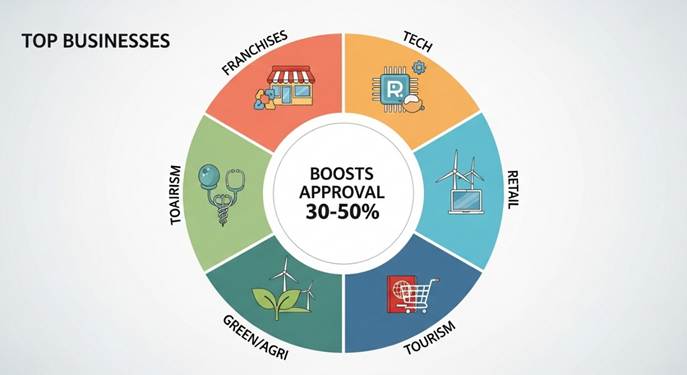
As a Canadian Immigration Business Advisor, I analyze what provinces are actually nominating. It is not just about having money; it is about economic need.
Choosing the right business is crucial—provinces prioritize ventures creating jobs, innovating, or filling labor gaps. Based on 2026 provincial priorities and economic reports, here are the top recommendations that align with PNP criteria (e.g., job creation, rural focus). These improve approval odds by demonstrating economic benefit. From an immigration and compliance perspective, provinces consistently favor businesses with High‑Success Business Categories such as:
- Business Succession (Buying an Existing Business): This is the #1 Golden Ticket. With Canada’s aging population, thousands of Baby Boomer business owners want to retire. Buying a local business often gets you double points in streams like BC and Alberta.
- Franchises (e.g., Tim Hortons, Subway, or Subway-inspired quick-service): Low-risk, proven models. Ideal for BC Regional or Alberta Rural streams; requires $100,000-$200,000 investment. Success factor: Creates 1-2 jobs quickly.
- Tech Startups or IT Services (e.g., software development, app consulting): High demand in Ontario and BC. Ontario’s ICT sector reduces net worth to $400,000 outside the GTA. Pairs well with job creation in digital communications.
- Trades & Construction Services: Construction trades and finishing trades companies, such as HVAC, plumbing, electrical contracting, and residential construction in rural areas.
- Childcare centers and early learning facilities
- Healthcare Support Businesses: Home care and senior support services, home care agencies, physiotherapy clinics, medical supply stores, and dental labs: Addresses aging population needs in Manitoba, Nova Scotia, and PEI. Minimal $150,000 investment; prioritizes in 2026 draws.
- Green Energy or Agri-Tech & Food Processing: Agricultural services and agri‑food operations Food processing and light manufacturing, specifically in Manitoba and Alberta. (e.g., solar installation, organic farming tech): Favored in Saskatchewan and New Brunswick for sustainability. Rural focus boosts points; e.g., Alberta Farm Stream variant.
- Digital Services (Outside Toronto/Vancouver): IT Services/ Consultancies tied to local SMEs (not pure startups)setting up in cities like Thunder Bay, Sudbury, or Kelowna.
- Tourism/Hospitality- Rural hospitality (hotels, motels, restaurants) (e.g., eco-lodges, food trucks in rural areas): Strong in Newfoundland and PEI. $100,000-$200,000 investment; exploratory visits help validate demand.
- Retail or E-Commerce (e.g., import/export stores for ethnic goods): Versatile for all provinces. In-Canada applicants can leverage existing networks; ensure active management.
- Automotive repair and heavy equipment services
- Trucking, logistics, and warehousing
Businesses That Raise Red Flags
- Purely speculative startups
- Cash‑intensive businesses with weak records
- Online‑only or remote businesses
- Real estate holding companies
- Businesses designed primarily for immigration purposes
Tip: Avoid passive investments like real estate—PNPs require 51%+ ownership and hands-on operation. Consult a business advisor for feasibility studies.
Province-by-Province Breakdown: Key Eligibility Requirements and Indicative Costs (2026-2027)
Note: Figures below reflect realistic operational thresholds used by provinces. Final requirements depend on invitation rounds and regional priorities.
Alberta (Rural Entrepreneur Stream)
Base Stream: Stream Name
Key Eligibility:
Age: 18+
Experience: 3 yrs ownership or 4 yrs management.
Language: CLB
Business: New/existing in rural (<100k pop.); create 1 job
Exploratory visit required
Net Worth: $300,000
Investment: $100,000
British Columbia (BC PNP – Entrepreneur Immigration)
Base Category:
Net Worth: $600,000
Investment: $200,000
Ownership: ≥51%
Jobs: 1 full‑time job
Language: CLB 4
Key Requirement:
Age: 19+
Experience: Relevant business/management
Language: CLB 4
Business: Create 1 job; active management
Competitive points system. Degree or 3+ years of ownership required.
Fees: ~$3,500 provincial + federal fees
Regional Pilot: $300,000 net worth / $100,000 investment.
Key Requirement: Mandatory exploratory visit. Community referral required.
Ontario (OINP – Entrepreneur Stream)
Base Category: Regional (Outside GTA)
Net Worth:
• GTA: $800,000–$1.5M
• Non‑GTA: $400,000–$800,000
Investment:
• GTA: $600,000
• Non‑GTA: $200,000
Basic Requirements
Age: 18+
Experience: 24 months of ownership
Language: CLB 4
Business: Create 2 jobs; GTA vs. outside
Ownership: ≥33%
Jobs: 1–2, Canadian/PR depending on location
Fees: ~$3,500 total provincial
Manitoba (MPNP – Business Investor Stream)
Base Category: Entrepreneur Pathway
Net Worth: $500,000
Investment:
• Winnipeg: $250,000 (New business)
• Rural: $150,000 (Business purchase)
Language: CLB 5
Jobs: 1
Key Requirement:
Age: 18+
3 years of experience or 4 yrs management
Language: CLB 5
Business: 51% ownership; net worth verified
An exploratory visit is recommended for points.
Fees: ~$2,500 provincial
Nova Scotia (NSNP – Entrepreneur)
Base Category: Entrepreneur
Net Worth: $600,000 ($400k outside Halifax)
Investment: $150,000
Ownership: ≥33%
Language: CLB 5
Operation Period: 12 months before nomination
Key Requirement:
Age: 21+
Experience: 3 yrs ownership or 5 yrs management
Language: CLB 5
Business: Active in NS; points-based
Invitation only. Focus on business succession.
New Brunswick (NBPNP – Business Immigration)
Base Stream: Entrepreneurial Stream
Net Worth: $500,000 ($300k farming)
Investment: $250,000 ($100k farming)
Basic Requirements:
Age: 19-59
Experience: 3 yrs business/management
Exploratory Visit: Mandatory
Language: CLB 4–5
Education: High school education
Prince Edward Island (PEI PNP – Business Work Permit Stream)
Base Stream: Business Impact (Work Permit)
Net Worth: ~$600,000
Investment: ~$150,000
Focus: Business succession and rural retention
Basic Requirements:
Age: 18+
Experience: 3 yrs business or 5 yrs management
Language: CLB 4
Business: 274 days/year presence
Newfoundland & Labrador (NLPNP – International Entrepreneur)
Base Stream: International Entrepreneur
Net Worth: $600,000
Investment: $200,000(new); $300,000 (purchase)
Requirements:
Age: 21-59
Experience: 2 yrs ownership or 5 yrs management
Language: CLB 4
Business Ownership: 33% ownership; interview required
Language: CLB 5
Yukon Business Nominee Program
Net Worth: $500,000
Liquid Assets: $300,000
Investment: $300,000
Ownership: ≥33%
Northwest Territories Business Stream
Net Worth: ~$500,000
Investment: $150,000–$300,000
Location‑dependent thresholds
Realistic End‑to‑End Process Timeline
- Exploratory visit & business planning: 2–4 months
- EOI submission to invitation: 3–12 months
- Work permit & establishment: 12–20 months
- Nomination to PR approval: 6–9 months
Total realistic timeline: 24–36 months
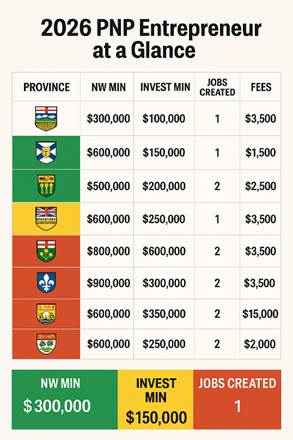
Note: Requirements are current as of Jan 2026 and subject to change. PNP streams vary by province, with most requiring an Expression of Interest (EOI) system, points grid (e.g., 60/100 minimum), and net worth verified by accountants. Indicative costs include fees, investments, and extras (e.g., legal: $5,000-$10,000; net worth audit: $4,000-$6,000). Data reflects 2026 updates; always check official sites as allocations may cap (e.g., Ontario: 17,872 nominations)
🔍 Key Comparison Table
| Province | Net Worth Min | Investment Min | Jobs Created | Fees |
| 🟩 Alberta | $300,000 | $100,000 | 1 | $3,500 |
| 🟩 Nova Scotia | $600,000 | $150,000 | 1 | $1,500 |
| 🟩 Saskatchewan | $500,000 | $200,000 | 2 | $2,500 |
| 🟨 British Columbia | $600,000 | $200,000 | 1 | $3,500 |
| 🟨 Manitoba | $500,000 | $250,000 | 1 | $2,500 |
| 🟥 Ontario | $800,000 | $600,000 | 2 | $3,500 |
| 🟥 Quebec | $900,000 | $300,000 | 2 | $15,000 |
| 🟥 New Brunswick | $600,000 | $250,000 | 2 | $2,000 |
| 🟥 Prince Edward Island | $600,000 | $250,000 | 2 | $10,000 |
Color Legend:
- 🟩 Green = Low-barrier entry (≤ $200k investment)
- 🟨 Yellow = Moderate barrier ($200k–$300k)
- 🟥 Red = High-barrier entry (≥ $250k investment or high fees)
💡 What to Consider
- Alberta stands out with the lowest investment requirement ($100k) and a single job creation target.
- Nova Scotia and Saskatchewan offer balanced entry points with moderate net worth and investment thresholds.
- Ontario and Quebec demand higher financial commitments, but may offer access to larger markets and infrastructure.
🧭 Choosing Your Path
Your ideal province depends on your business type, available capital, and long-term goals. Whether you’re launching a tech startup, acquiring a franchise, or investing in agriculture, there’s a stream that fits.
The Most Realistic Immigration Pathway: Step-by-Step Guide
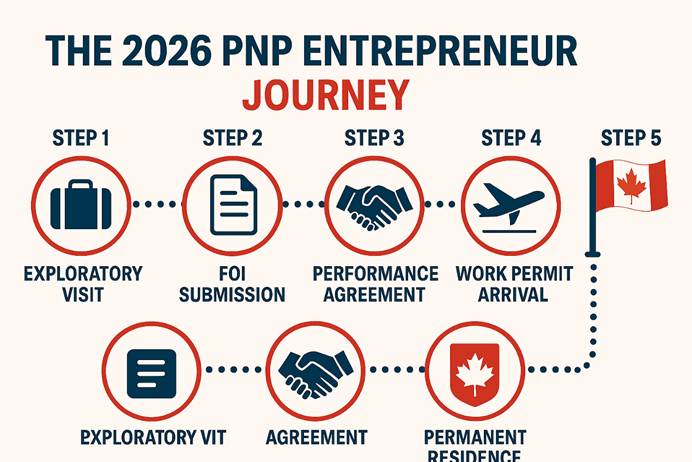
Do not expect to get a PR visa in your passport before you board the plane. The PNP process typically takes 12-24 months to PR. Here’s the realistic sequence, blending my RCIC expertise with business advisory insights:
- Research, Self-Assessment, and Net Worth Verification (1-3 Months): Choose a province based on your profile (e.g., rural for Alberta). Complete an intake questionnaire (see below). Verify net worth via CPA audit. Score on points grid (experience, investment, language).
- Exploratory Visit (1-2 Weeks, If Required): Mandatory for Alberta, BC, NL, etc. You obtain a visitor visa and spend 5-10 days in the target province. Visit as a tourist (eTA/visa). Meet economic development officers and realtors in respective communities, scout locations, and get endorsements. Cost: $2,000-$5,000 travel. Builds business plan credibility. This is crucial for points
- EOI & Invitation, Business Incorporation and Setup (3-6 Months): Submit EOI/application online. If your score is high enough, the province invites you to apply and prepare a business plan (e.g., via a consultant: $5,000). Incorporate federally/provincially ($200-$500). Secure work permit support letter from province (owner-operator LMIA-exempt). Apply for a work permit via IRCC ($155 + biometrics $85).
- The Interview & Performance Agreement: You interview with provincial officers. If successful, you sign a contract promising to invest $X and hire Y people.
- Work Permit Arrival and Business Operation (12-24 Months): You receive a Letter of Support to apply for a work permit. You land in Canada with your family. Kids go to school; spouse gets an open work permit. Invest funds, hire staff, operate actively (51%+ time). Meet performance agreement (e.g., revenue targets, jobs created). Provinces monitor via reports.
- Nomination and PR Application (3-6 Months): You prove you met the contract terms. Achieve milestones? Get a nomination certificate. Apply for PR via IRCC (online, 6 months processing). Include spouse/kids. Post-PR: Full work rights, citizenship path after 3 years.
For in-Canada applicants: Start on visitor status, incorporate immediately, then apply for a work permit. Success tip: Partner with local mentors; avoid sole proprietorships for scalability.
Frequently Asked Questions (FAQs)
- How do I verify my net worth? Use a designated accounting firm (e.g., via provincial list). Costs $4,000-$6,000; must be legally acquired, unencumbered funds.
- What language tests are accepted? IELTS (General), CELPIP, or TEF for CLB 4-5. Test early—valid 2 years.
- Can I include my spouse’s experience/net worth? Yes, combined for net worth; spouse needs CLB 4 for PR.
- What if my business fails? Most deposits are refundable if made in good faith, but if the nomination is revoked, reapply after fixes.
- Is PNP faster than Express Entry for business? Yes, no CRS points needed; but integrate with EE for faster PR if eligible.
- Are there scams? Yes—avoid guaranteed agents. Use only RCICs; report to IRCC.
- Can I just buy a house and get PR? No. Real estate investment (passive) does not qualify. You must actively manage a business.
- Why is the Federal Start-Up Visa not on this list? As of Jan 1, 2026, the SUV program is closed to new applicants without a 2025 commitment certificate.
- Can I buy a franchise? Yes, in many provinces (like BC and Manitoba), buying an established franchise is a safe and permitted way to meet the requirements, provided you manage it daily.
- Can I buy an existing business instead of starting one?
Yes. In fact, business succession purchases are strongly favored. - Can I apply while in Canada as a visitor or worker?
Yes, provided you maintain legal status. - Is permanent residence guaranteed?
No. Nomination depends on meeting the performance agreement.
Final Professional Note
The PNP entrepreneur pathway is not a shortcut—it is a structured, compliance‑driven process designed for serious businesspeople. When executed properly, it remains one of the most powerful and realistic routes to Canadian permanent residence today.
To check your eligibility for any of the pathways, complete our “Canada PNP Entrepreneur Immigration – Eligibility Assessment”: https://docs.google.com/forms/d/e/1FAIpQLSfj55qvnHVti_1fWbuTmIJPqaqDTNlak0-ShVG8AyleGs04yw/viewform?usp=sharing&ouid=104246563010315991401
Relevant Official Government Website Links
For the most up-to-date info (as of January 2026), visit:
- IRCC PNP Overview: https://www.canada.ca/en/immigration-refugees-citizenship/services/immigrate-canada/provincial-nominees.html
- Alberta AAIP Rural Entrepreneur: https://www.alberta.ca/aaip-rural-entrepreneur-stream.aspx
- BC Entrepreneur Immigration: https://www.welcomebc.ca/Immigrate-to-B-C/Entrepreneur-Immigration
- Manitoba Entrepreneur Pathway: https://immigratemanitoba.com/immigrate/bis/entrepreneur
- New Brunswick Entrepreneurial: https://www2.gnb.ca/content/gnb/en/corporate/promo/immigration/immigrating-to-nb/nb-immigration-program-streams/nb-business-immigration-stream.html
- Newfoundland International Entrepreneur: https://www.gov.nl.ca/immigration/immigrating-to-newfoundland-and-labrador/international-entrepreneur/ (Check for updates)
- Nova Scotia Entrepreneur: https://novascotiaimmigration.com/move-here/entrepreneur-stream/
- Ontario Entrepreneur: https://www.ontario.ca/page/ontario-immigrant-nominee-program-oinp-entrepreneur-stream
- PEI Business Impact: https://www.princeedwardisland.ca/en/topic/business-impact-category
- Saskatchewan Entrepreneur: https://www.saskatchewan.ca/residents/moving-to-saskatchewan/live-in-saskatchewan/by-immigrating/saskatchewan-immigrant-nominee-program/entrepreneur-and-farm/start-a-business-in-saskatchewan-as-a-entrepreneur/saskatchewan-entrepreneur-stream
Tip: Provinces update streams quarterly; e.g., Saskatchewan delayed 2026 draws for criteria tweaks. Bookmark and subscribe to alerts.
Business Succession Resources:
- BizBuySell Canada – Largest marketplace for businesses for sale- https://www.bizbuysell.com/canada-businesses-for-sale/
- Canadian Federation of Independent Business (CFIB) – Resources on business succession. https://www.cfib-fcei.ca/en/
- Provincial Economic Development Offices – Each province has regional offices that maintain lists of businesses seeking buyers. Provincial Economic Development Offices:
- Alberta: Ministry of Jobs, Economy, Trade and Immigration
- British Columbia: Ministry of Jobs and Economic Growth
- Manitoba: Department of Business, Mining, Trade and Job Creation
- New Brunswick: Opportunities NB (ONB)
- Newfoundland and Labrador: Department of Industry, Energy and Technology
- Nova Scotia: Department of Economic Development
- Ontario: Ministry of Economic Development, Job Creation and Trade
- Prince Edward Island: Department of Economic Development, Innovation and Trade
- Quebec: Ministère de l’Économie, de l’Innovation et de l’Énergie
- Saskatchewan: Ministry of Trade and Export Development
Regional Development Agencies (Federal Partners)
In addition to provincial offices, the federal government operates regional agencies that provide funding and support tailored to specific provinces: Atlantic Canada (NB, NL, NS, PE): Atlantic Canada Opportunities Agency (ACOA)
- Ontario: FedDev Ontario (Southern) and FedNor (Northern)
- Prairies (AB, SK, MB): Prairies Economic Development Canada (PrairiesCan)
- Pacific (BC): Pacific Economic Development Canada (PacifiCan)
- Quebec: Canada Economic Development for Quebec Regions (CED)